المعرفة في صوتها: الشاعرات العربيات وصناعة معرفة المرأة
مقدّمة: منذ أربعة عشر قرناً والمرأة العربية تكتب الشعر — وكان الشعر واحداً من أهم الطرق التي تعلّمت بها المرأة العربية وعلّمت بها وأُسمع صوتها. من مراثي الخنساء إلى الشعر الحرّ عند نازك الملائكة وأنطولوجيات سلمى الخضراء الجيوسي، لم تكتب الشاعرات أبياتاً جميلة فحسب، بل بنينَ الصفوف الدراسية والمجلات والأرشيفات التي قامت عليها معرفة المرأة في العالم العربي.
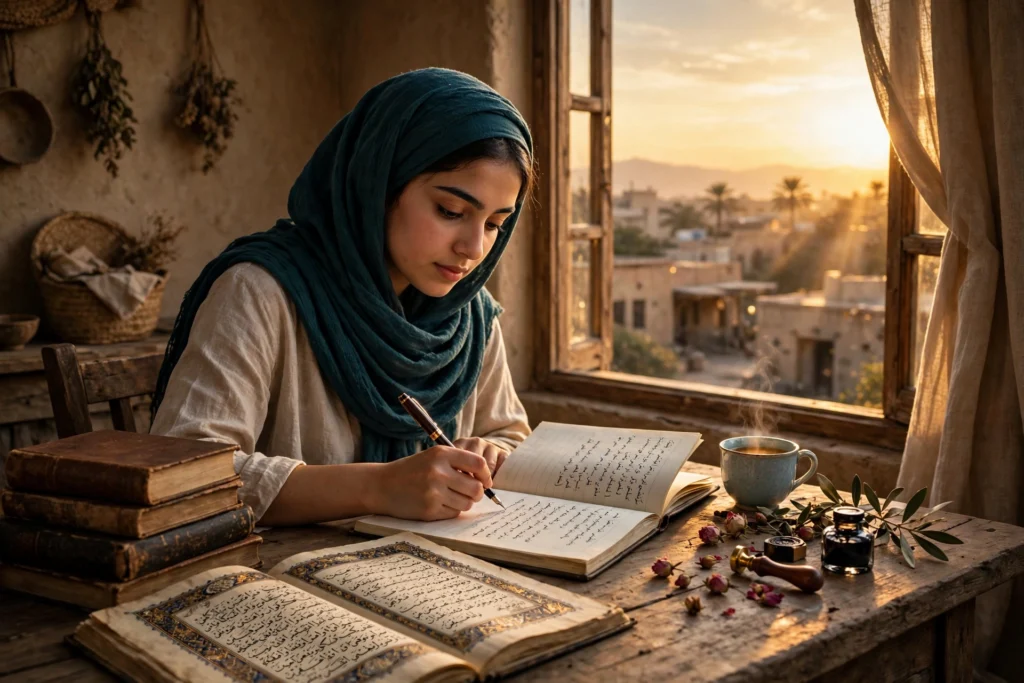
ما “معرفة المرأة”؟ إنها ليست مادة في منهج دراسي. إنها المعرفة التي تحملها المرأة وتنتجها وتنقلها: كيف تقرأ العالم، وكيف تسمّي تجربتها، وكيف تحفظ ذاكرةً ينساها السجلّ الرسمي. وفي التاريخ العربي، كان الشعر واحداً من أهم حوامل هذه المعرفة — لأن القصيدة يمكن أن تُحفظ وتُروى وتُحمل عبر الحدود والأجيال دون مطبعة. وقد فهمت الشاعرات ذلك مبكراً، فاستخدمن القصيدة مدرسةً وصحيفةً ومكتبةً في آن واحد.
تبدأ الحكاية قبل الطباعة بزمن طويل. فالخنساء (575–645)، أشهر شاعرات العربية الأولى، اشتهرت بمراثيها لأخويها صخر ومعاوية، اللذين قُتلا في حروب القبائل. ولم تكن مراثيها حزناً خاصاً، بل تاريخاً عاماً: ففي مجتمع بلا أرشيف مكتوب، كانت المرثية هي الطريقة التي يتذكّر بها الناس موتاهم، وكان صوت امرأة هو الذي يقوم بالتذكير. وتذكر المصادر القديمة أن النبي محمداً طلب منها أن تُنشد وأثنى على شعرها. وبعد قرن، حوّلت رابعة العدوية (717–801)، عابدة البصرة ومتصوّفتها، الشعر نحو نوع آخر من المعرفة — معرفة الله. وقصائدها القصيرة في الحب الإلهي، التي ما زالت تُقتبس في التعليم الصوفي حتى اليوم، جعلت من امرأةٍ عالِمةً باللاهوت شعراً، في زمن كان اللاهوت فيه من كتابة الرجال.
أما أوضح مثال مبكر على الشعر بوصفه مدرسة للنساء فيأتي من قرطبة. فولادّة بنت المستكفي (994–1091)، ابنة الخليفة الأموي محمد الثالث، ورثت أملاك أبيها فاستخدمتها لفتح صالون أدبي في قصرها — كان، بحسب المؤرخ ابن بسّام، أبهى مجالس المدينة. وكان صالونها، في الواقع، مدرسةً للنساء من كل الطبقات، من الأميرات إلى الإماء، حيث كان الشعر يُعلَّم ويُتداول. وكانت ولّادة نفسها مشهورة بالتحدّي: تمشي في الشوارع سافرة، وقد طرّزت على ثيابها أبياتاً منها قولها: «أنا والله أصلح للمعالي / وأمشي مشيتي وأتيه تيها». ولم يبقَ من شعرها سوى تسع قصائد. وهذا الفقد جزء من الحكاية: فمعرفة النساء في العصر الكلاسيكي بقيت في الغالب بالذاكرة وفي أنطولوجيات الرجال — ولهذا كانت النساء اللواتي بنين مؤسساتهنّ الخاصة مهمّات إلى هذا الحد.
وغيّرت الطباعة حجم الأمر كله. ففي تشرين الثاني/نوفمبر 1892، أطلقت هند نوفل، الصحافية اللبنانية التي استقرت في الإسكندرية، مجلة الفتاة، أول مجلة نسائية في العالم العربي. كانت، على حدّ تعبيرها، مجلة «للنساء ومن النساء وعن النساء»، تتناول العلم والتاريخ والأدب والفكاهة وتدافع عن حقوق المرأة. ولم تعش سوى عامين — توقفت عندما تزوجت نوفل — لكنها بدأت نوعاً جديداً: فتبعتها نحو ثلاثين مجلة نسائية في مصر قبل عام 1919. كانت المجلة صفّاً دراسياً مطبوعاً، تقول لقارئاتها إن أفكارهنّ وتعليمهنّ وحقوقهنّ مواضيع جديرة بالنقاش العام.
وبعد جيل، فتحت مي زيادة (1886–1941)، الكاتبة اللبنانية-الفلسطينية، نوعاً آخر من الصفوف: صالونها الأدبي الشهير في القاهرة، الذي استمر من عام 1913 حتى ثلاثينيات القرن العشرين. كان الكتّاب والمفكرون يجتمعون في غرفها متساوين، وكانت زيادة نفسها — الكاتبة والشاعرة والمترجمة — مركز الحديث. وكان الصالون مهماً لأنه منح النساء مكاناً في الحياة الفكرية للعاصمة لم تكن الجامعة أو الصحيفة لتقدّمه لهنّ بعد.
وتُظهر فدوى طوقان (1917–2003)، الشاعرة الفلسطينية من نابلس، ما كان الشعر قادراً على فعله حتى حين كان الصالون بعيد المنال. بدأت الكتابة في مجتمع لم يكن يشجّع تعليم البنات، فعلّمت نفسها بنفسها في البيت في الغالب. وصدرت مجموعتها الأولى عام 1952، وعلى مدى خمسة عقود حملت قصائدها الحياة الداخلية للمرأة الفلسطينية — الحب والحبس والمنفى والمقاومة — إلى الأدب العربي، ثم إلى العالم عبر الترجمة. وبالنسبة إلى كثير من القرّاء، كانت طوقان أول صوت لامرأة فلسطينية يسمعونه. كان الشعر تعليمها ومنبرها العام في آن واحد.
وجاء الانقطاع الحاسم في بغداد عام 1947. ففي السابعة والعشرين من تشرين الأول/أكتوبر من ذلك العام، سمعت نازك الملائكة (1923–2007)، وكانت في الرابعة والعشرين، تقارير إذاعية عن وباء الكوليرا الذي يجتاح مصر، فنظمت قصيدة عنه. ونُشرت «الكوليرا» في مجلة العروبة البيروتية في 1 كانون الأول/ديسمبر 1947، وتُعدّ على نطاق واسع أول قصيدة منشورة في الشعر الحرّ العربي. وحافظت الملائكة على البحور الكلاسيكية لكنها تركت عدد التفعيلات يتغيّر من سطر إلى آخر، فكسرت أربعة عشر قرناً من تساوي الأسطر. وصدرت مجموعتها الأولى، عاشقة الليل، في العام نفسه، وافتتحت مجموعتها الثانية، شظايا ورماد (1949)، بمقدمة نظرية تدافع عن الشكل الجديد. وكان الانقطاع مشتركاً — فقد نشر بدر شاكر السياب مجموعته في الشعر الحرّ بعد أسابيع — لكن الملائكة كانت منظِّرة الحركة كما كانت رائدتها، وربطت الشكل الجديد صراحة بحرية المرأة: فتجربة المرأة، على حدّ قولها، تحتاج لغةً لا تستطيع الأشكال القديمة حملها. وأصبح الشعر الحرّ اللغة التي تتحدث بها الشاعرات العربيات لسبعين عاماً بعد ذلك.
وإذا كانت الملائكة قد كسرت الشكل، فإن سلمى الخضراء الجيوسي (1925–2023) بنت الجسر. فقد كانت الجيوسي شاعرة بنفسها — صدرت مجموعتها الأولى، العودة من النبع الحالم، عام 1960 — لكن عملها الدائم كان ناقدةً ومترجمةً ومُعِدّة أنطولوجيات. فدراستها للدكتوراه، الاتجاهات والحركات في الشعر العربي الحديث (1977)، رسمت خريطة التقليد الحديث؛ وفي عام 1980 أسست مشروع ترجمة الأدب العربي (PROTA)؛ وفي عام 1987 حرّرت الشعر العربي الحديث: أنطولوجيا، التي قدّمت أكثر من تسعين شاعراً عربياً إلى القرّاء بالإنجليزية. فالأنطولوجيا معرفةٌ تُصنع لتدوم: إنها تقرر من يُتذكَّر ومن يُقرأ. واستخدمتها الجيوسي لتتأكد من أن الشاعرات في السجلّ، لا خارجه.
والعمل نفسه مستمر اليوم. فأنطولوجيا شعر المرأة العربية، التي حرّرتها نتالي حنظل وصدرت أول مرة عام 2001، ظهرت في طبعة الذكرى الخامسة والعشرين عام 2026، جامعةً ثلاثة وثمانين شاعرة — من فدوى طوقان ونازك الملائكة إلى الشاعرة اللبنانية-الفرنسية أندريه شديد، والشاعرة اللبنانية-الأمريكية إيتيل عدنان (1925–2021)، وأصوات أصغر من الشتات مثل سهير حماد ودنيا ميخائيل. والأنطولوجيا أرشيف مضاد: دليل على أن شعر المرأة العربية لم يكن يوماً هامشاً، بل تقليداً قائماً بذاته.
وما زال التقليد يُكتب. ففي الشتات، تكتب شاعرات مثل السودانية-الأمريكية صافية الحلو والمصرية إيمان مرسال بالإنجليزية والعربية عن الهجرة والجسد والانتماء — مواضيع لم تكن نساء جيل جدّاتهنّ يستطعن تسميتها علناً بالكاد. وداخل العالم العربي، تقرأ الشابات ويكتبن الشعر على هواتفهنّ، في أمسيات الشعر المنطوق وعلى وسائل التواصل، حيث يمكن لقصيدة أن تصل إلى آلاف في ساعة. تغيّرت الأدوات، ولم يتغيّر النمط: تكتب امرأة قصيدة، فتعلّم القصيدة أحداً شيئاً لم يعلّمه إياه كتاب مدرسي.
هذا هو الخيط الممتد عبر أربعة عشر قرناً. فالشاعرات العربيات لم ينتجن الأدب فحسب، بل أنتجن المعرفة — والأهم من ذلك، أنتجن وسائل نقلها: الصالون والمجلة والأنطولوجيا والترجمة. فحين علّمت ولّادة الشعر لنساء قرطبة، وحين طبعت نوفل مجلة «لأخواتها»، وحين بنت الجيوسي مشروع ترجمة ليقرأ العالم الشعراء العرب، كنّ يفعلن الشيء نفسه: يتأكدن من أن ما تعرفه النساء لن يضيع. كانت القصيدة هي الوعاء، وما زالت المعرفة تسافر فيه.
المصادر — المقال
- روبن كريسويل، «نازك الملائكة وشعرية القومية العربية»، Critical Inquiry 46 (خريف 2019) — قصيدة «الكوليرا» كُتبت في 27 تشرين الأول/أكتوبر 1947 ونُشرت في العروبة في 1 كانون الأول/ديسمبر 1947؛ أول قصيدة منشورة في الشعر الحرّ.
https://www.academia.edu/40505569/Nazik_al_Malaika_and_the_Poetics_of_Pan_Arabism - «نازك الملائكة»، Encyclopedia.com — 1923–2007؛ المجموعة الأولى عاشقة الليل (1947)؛ الثانية شظايا ورماد (1949).
http://www.encyclopedia.com/history/encyclopedias-almanacs-transcripts-and-maps/nazik-al-malaika - مكتبات الجامعة الأمريكية في بيروت، «سيرة هند نوفل»، رائدات الصحافة العربية (1892–1925) — مجلة الفتاة أُطلقت في الإسكندرية عام 1892، أول مجلة نسائية في العالم العربي.
https://online-exhibit.aub.edu.lb/exhibits/show/women-pioneers-in-arab-press/nawfal-biography - «مجلة الفتاة»، ويكيبيديا — العدد الأول في تشرين الثاني/نوفمبر 1892؛ صدرت 1892–1894.
https://en.wikipedia.org/wiki/Al-Fatat_(periodical) - History Today، «شاعرة الإسلام في الحب» — صالون ولّادة في قرطبة، ومدرستها للنساء من كل الطبقات، وأثوابها المطرّزة.
https://www.historytoday.com/archive/islamic-poet-love - «ولادة بنت المستكفي»، ويكيبيديا — 994–1091؛ ابنة الخليفة محمد الثالث؛ بقي من شعرها تسع قصائد.
https://en.wikipedia.org/wiki/Wallada_bint_al-Mustakfi - سيرة سلمى الخضراء الجيوسي، PalQuest (الموسوعة التفاعلية للقضية الفلسطينية) — وُلدت 16 نيسان/أبريل 1925 وتوفيت 20 نيسان/أبريل 2023؛ المجموعة الأولى 1960؛ تأسيس PROTA عام 1980؛ الشعر العربي الحديث: أنطولوجيا (1987) تضم أكثر من تسعين شاعراً.
https://www.palquest.org/en/biography/9861/salma-khadra-jayyusi - مجلة «العربي الجديد» (ثقافة)، عن طبعة الذكرى الخامسة والعشرين من شعر المرأة العربية، تحرير نتالي حنظل، Interlink Books، 2026 — ثلاث وثمانون شاعرة.
https://www.instagram.com/p/Dc8jM5AGyEN/ - عن الخنساء ورابعة العدوية ومي زيادة وفدوى طوقان وإيتيل عدنان (التواريخ والمسيرات): مراجع سير ذاتية معتمدة، منها رضوى عاشور وفريال غزول وحسنى رضا-مقدسي (محررات)، الكاتبات العربيات: دليل مرجعي نقدي، 1873–1999 (الجامعة الأمريكية بالقاهرة، 2008).
The Knowledge in Her Voice: Arab Women Poets and the Making of Women’s Knowledge
Standfirst: For fourteen centuries, Arab women have written poetry — and poetry has been one of the main ways Arab women have learned, taught, and been heard. From the elegies of al-Khansa to the free verse of Nazik al-Malaika and the anthologies of Salma Khadra Jayyusi, women poets did more than write beautiful lines. They built the classrooms, the magazines, and the archives of women’s knowledge in the Arab world.
What is “women’s knowledge”? It is not a subject on a syllabus. It is the knowledge women hold, produce, and pass on: how to read the world, how to name an experience, how to keep a memory alive when the official record forgets it. In Arab history, poetry has been one of the chief carriers of that knowledge — because a poem can be memorized, recited, and carried across a border or a generation without a printing press. Women poets understood this early, and they used the poem as a school, a newspaper, and a library at once.
The story begins long before print. Al-Khansa (575–645), the most famous woman poet of early Arabia, made her name with elegies for her brothers Sakhr and Mu’awiya, killed in tribal wars. Her laments were not private grief. They were public history: in a society without written archives, the elegy was how a community remembered its dead, and a woman’s voice did the remembering. Classical sources record that the Prophet Muhammad asked her to recite and praised her verse. A century later, Rabi’a al-Adawiyya (717–801), the mystic of Basra, turned poetry toward a different kind of knowledge — the knowledge of God. Her short poems of divine love, still quoted in Sufi teaching today, made a woman a theologian in verse at a time when theology was written by men.
But the clearest early example of poetry as a women’s school comes from Cordoba. Wallada bint al-Mustakfi (994–1091), daughter of the Umayyad Caliph Muhammad III, inherited her father’s property and used it to open a literary salon in her own mansion — the most illustrious gathering in the city, according to the chronicler Ibn Bassam. Her salon was also, in effect, a school for women of all backgrounds, from royalty to enslaved women, where poetry was taught and debated. Wallada herself was famously defiant: she walked the streets unveiled and had verses embroidered on her robes, including the line, “I am, by God’s will, fit for high positions! And I walk with pride along my own road.” Only nine of her poems survive. That loss is part of the story. Women’s knowledge in the classical age survived mostly by memory and in men’s anthologies — which is why the women who built their own institutions matter so much.
Print changed the scale. In November 1892, Hind Nawfal, a Lebanese journalist who had settled in Alexandria, launched al-Fatat (The Young Girl), the first women’s magazine in the Arab world. It was, in her words, a journal “for, by, and about women,” covering science, history, literature, and humour, and defending women’s rights. It lasted only two years — it closed when Nawfal married — but it started a genre: nearly thirty women’s journals followed in Egypt before 1919. The magazine was a classroom in print. It told its readers that their thoughts, their education, and their rights were subjects fit for public discussion.
A generation later, May Ziadeh (1886–1941), the Lebanese-Palestinian writer, opened a different kind of classroom: her famous literary salon in Cairo, which ran from 1913 into the 1930s. Writers and thinkers gathered in her rooms as equals, and Ziadeh herself — essayist, poet, translator — was the centre of the conversation. The salon mattered because it gave women a place in the intellectual life of the capital that no university or newspaper would yet offer them.
Fadwa Tuqan (1917–2003), the Palestinian poet from Nablus, shows what poetry could do when even the salon was out of reach. She began writing in a society that discouraged girls’ schooling, teaching herself largely at home. Her first collection appeared in 1952, and over five decades her poems carried the inner life of Palestinian women — love, confinement, exile, resistance — into Arabic literature and then, in translation, into the world. For many readers, Tuqan was the first Palestinian woman’s voice they had ever heard. Poetry was her education and her public platform at once.
The most decisive break came in Baghdad in 1947. Nazik al-Malaika (1923–2007), then twenty-four, heard radio reports of the cholera epidemic raging in Egypt and composed a poem about it on 27 October 1947. “Cholera” was published in the Beirut magazine al-‘Uruba on 1 December 1947, and it is widely credited as the first published poem in Arabic free verse. Al-Malaika kept the classical metres but let the number of feet vary from line to line, breaking fourteen centuries of uniform line lengths. Her first collection, ‘Ashiqat al-Layl (Lover of the Night), appeared the same year, and her second, Shazaya wa Ramad (Splinters and Ashes, 1949), opened with a theoretical preface defending the new form. The breakthrough was shared — Badr Shakir al-Sayyab published his own free-verse collection within weeks — but al-Malaika was the movement’s theorist as well as its pioneer, and she linked the new form explicitly to women’s freedom: a woman’s experience, she argued, needed a language that the old forms could not hold. Free verse became the language in which Arab women poets would speak for the next seventy years.
If al-Malaika broke the form, Salma Khadra Jayyusi (1925–2023) built the bridge. Jayyusi was herself a poet — her first collection, Return from the Dreamy Fountain, appeared in 1960 — but her lasting work was as a critic, translator, and anthologist. Her doctoral study, Trends and Movements in Modern Arabic Poetry (1977), mapped the modern tradition; in 1980 she founded the Project of Translation from Arabic (PROTA); and in 1987 she edited Modern Arabic Poetry: An Anthology, which put more than ninety Arab poets before English readers. Anthologies are knowledge made durable: they decide who is remembered and who is read. Jayyusi used them to make sure women poets were in the record, not outside it.
The same work continues today. Nathalie Handal’s anthology The Poetry of Arab Women, first published in 2001, appeared in a 25th-anniversary edition in 2026, gathering eighty-three poets — from Fadwa Tuqan and Nazik al-Malaika to the Lebanese-French poet Andrée Chedid, the Lebanese-American Etel Adnan (1925–2021), and younger diaspora voices such as Suheir Hammad and Dunya Mikhail. The anthology is a counter-archive: proof that Arab women’s poetry was never a footnote, but a tradition in its own right.
And the tradition is still being written. In the diaspora, poets such as the Sudanese-American Safia Elhillo and the Egyptian Iman Mersal write in English and Arabic about migration, the body, and belonging — subjects their grandmothers’ generation could barely name in public. Inside the Arab world, young women read and write poetry on their phones, in spoken-word nights and on social media, where a poem can reach thousands in an hour. The tools have changed. The pattern has not: a woman writes a poem, and the poem teaches someone something that no textbook taught her.
That is the thread running through fourteen centuries. Arab women poets did not only produce literature. They produced knowledge — and, just as importantly, they produced the means of passing it on: the salon, the magazine, the anthology, the translation. When Wallada taught poetry to the women of Cordoba, when Nawfal printed a magazine for her “sisters,” when Jayyusi built a translation project so that the world could read Arab poets, each of them was doing the same thing: making sure that what women knew would not be lost. The poem was the vessel. The knowledge is still travelling in it.
Sources — English
- Robyn Creswell, “Nazik al-Mala’ika and the Poetics of Pan-Arabism,” Critical Inquiry 46 (Autumn 2019) — “Cholera” composed 27 October 1947, published in al-‘Uruba 1 December 1947; first published free-verse poem.
https://www.academia.edu/40505569/Nazik_al_Malaika_and_the_Poetics_of_Pan_Arabism - “Nazik al-Mala’ika,” Encyclopedia.com — 1923–2007; first collection ‘Ashiqat al-Layl (1947); second collection Shazaya wa Ramad (1949).
http://www.encyclopedia.com/history/encyclopedias-almanacs-transcripts-and-maps/nazik-al-malaika - AUB Libraries, “Hind Nawfal Biography,” Women Pioneers in Arab Press (1892–1925) — al-Fatat launched in Alexandria in 1892, first women’s magazine in the Arab world.
https://online-exhibit.aub.edu.lb/exhibits/show/women-pioneers-in-arab-press/nawfal-biography - “Al-Fatat (periodical),” Wikipedia — first issue November 1892; published 1892–1894.
https://en.wikipedia.org/wiki/Al-Fatat_(periodical) - History Today, “Islamic Poet of Love” — Wallada’s salon in Cordoba, her school for women of all backgrounds, her embroidered robes.
https://www.historytoday.com/archive/islamic-poet-love - “Wallada bint al-Mustakfi,” Wikipedia — 994–1091; daughter of Caliph Muhammad III; nine poems survive.
https://en.wikipedia.org/wiki/Wallada_bint_al-Mustakfi - Salma Khadra Jayyusi biography, PalQuest (Interactive Encyclopedia of the Palestine Question) — born 16 April 1925, died 20 April 2023; first collection 1960; PROTA founded 1980; Modern Arabic Poetry: An Anthology (1987) with more than ninety poets.
https://www.palquest.org/en/biography/9861/salma-khadra-jayyusi - Al Araby Al Jadeed (culture), on the 25th-anniversary edition of The Poetry of Arab Women, ed. Nathalie Handal, Interlink Books, 2026 — eighty-three poets.
https://www.instagram.com/p/Dc8jM5AGyEN/ - For al-Khansa, Rabi’a al-Adawiyya, May Ziadeh, Fadwa Tuqan, and Etel Adnan (dates and careers): standard biographical references, including Radwa Ashour, Ferial J. Ghazoul, and Hasna Reda-Mekdashi (eds.), Arab Women Writers: A Critical Reference Guide, 1873–1999 (American University in Cairo Press, 2008).